Subterranean termite colonies require constant contact with ground moisture, entering buildings through foundation cracks as small as 1/32 of an inch or by building shelter tubes across exposed masonry. In older…
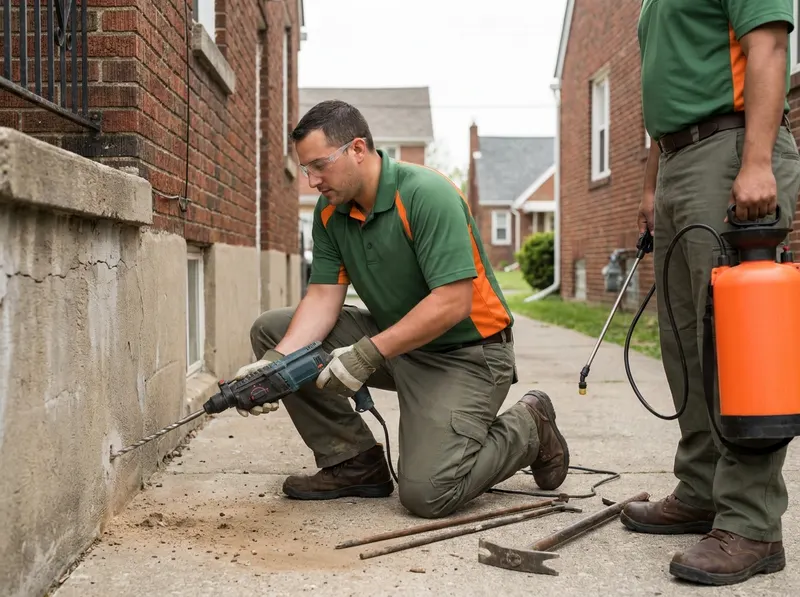
Subterranean termite colonies require constant contact with ground moisture, entering buildings through foundation cracks as small as 1/32 of an inch or by building shelter tubes across exposed masonry. In older neighborhoods like Boston-Edison, Indian Village, and Palmer Woods, historic fieldstone and masonry foundations present significant ground contact where wooden sill plates directly interface with moist soil. A liquid soil trenching treatment places a non-repellent barrier 6 inches wide and 6 inches deep around the foundation perimeter, allowing foraging workers to unknowingly track the active ingredient back to the central nest, neutralizing the colony within 60 to 90 days. For slab foundations common in Southwest Detroit and updated multi-family units across Midtown and Woodbridge, sub-slab injection creates an unbroken defensive curtain without structural alteration.
Selecting between comprehensive liquid perimeter barriers and localized baiting systems depends on structural access and soil drainage. A complete liquid barrier provides immediate continuous soil saturation that blocks worker access for up to 5 to 10 years, making it the practical choice for active, heavy infestations where subterranean galleries have already compromised floor joists. In contrast, in-ground bait stations placed every 10 to 15 linear feet offer ongoing suppression with minimal soil disturbance, which suits properties with extensive decorative pavers, dense landscaping, or sensitive water tables near Belle Isle Park. The trade-off involves response time: liquid treatments halt wood consumption immediately upon chemical contact, whereas bait matrices require workers to feed, molt, and pass the chitin-synthesis inhibitor to the queen over several weeks.
Effective structural defense extends beyond surface chemical applications to eliminate biological reentry. In vintage brick frame homes in Corktown and Rosedale Park, foundation settling creates subtle settlement fissures around plumbing penetrations and basement windows that draw termites upward toward wall studs. Mechanical exclusion seals these subterranean bypass routes using non-porous structural sealants, terminating the high-humidity microclimates that termites rely on for survival. Modifying exterior soil grades so earth remains at least 6 inches below structural woodwork permanently disrupts subterranean runways, shielding the structural frame without locking residents into rigid annual service commitments.
Every job gets a firm, written price after a free on-site visit.
Tell us about your subterranean termite treatment job in Detroit and we'll send a clear, written quote, usually the same day.
 Orelvo Pest Prevention