Perimeter barrier applications fit properties experiencing active seasonal migrations of ground-dwelling arthropods across porous foundations or unsealed perimeter sills. In historic brick and limestone foundations…
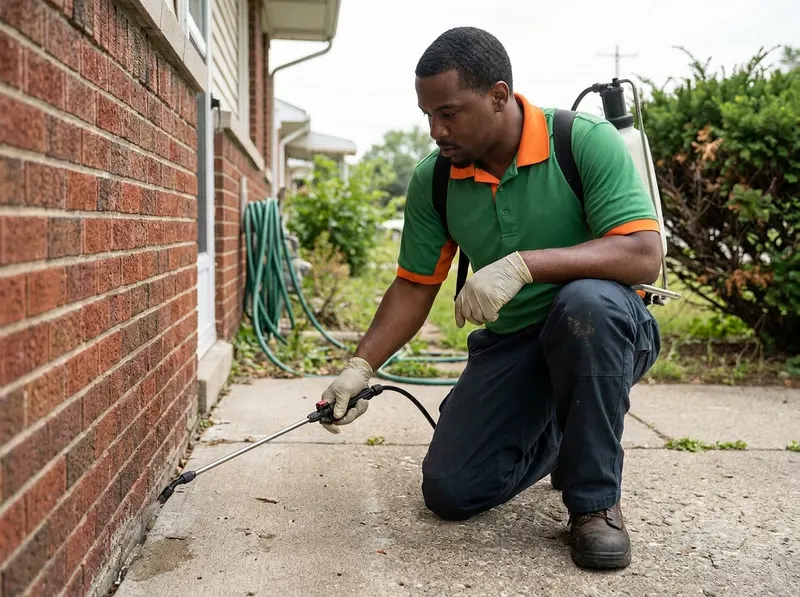
Perimeter barrier applications fit properties experiencing active seasonal migrations of ground-dwelling arthropods across porous foundations or unsealed perimeter sills. In historic brick and limestone foundations common across Indian Village, Boston-Edison, and Corktown, mortar settling and ground shifts create microscopic gaps where insects seek winter shelter or summer moisture. Applying an exterior band arrests foraging trails before insects reach wall voids, subfloors, or dry-food pantry storage. The trade-off involves application location versus direct knockdown: a perimeter barrier relies on insects traversing an external treated band and does not replace direct indoor localized baiting when an established internal population already occupies wall cavities.
Soil types and exterior finishes in Woodbridge, Midtown, and Palmer Woods alter the longevity and absorption of barrier treatments. Dense clay-loam soils and shaded tree canopies along Rosedale Park slow product photodegradation, retaining active residual levels for roughly 60 to 90 days. Conversely, unshaded perimeter pea gravel, sand-heavy beds, and direct concrete interfaces adjacent to heavy urban streets in Southwest Detroit require specific flowable micro-encapsulated formulations that withstand rain rinse-off and radiant heat up to 130 degrees Fahrenheit along foundation skirts.
Structural protection relies on methodical lifecycle disruption rather than continuous interior spraying. 1. Technicians complete an exterior perimeter audit, measuring total linear wall distance and identifying soil contact vulnerabilities. 2. Low-hanging vegetation touching siding within 12 inches is documented, followed by liquid barrier application delivering an even coat along 3 vertical feet of foundation and 3 horizontal feet of soil. 3. Granular moisture-resistant barrier bands are positioned across mulched flowerbeds. 4. Sealable expansion joints around basement egress windows and water supply penetrations are recorded for physical mechanical exclusion.
Every job gets a firm, written price after a free on-site visit.
Tell us about your perimeter crawling insect barrier job in Detroit and we'll send a clear, written quote, usually the same day.
 Orelvo Pest Prevention