Aerial nests constructed by paper wasps and bald-faced hornets routinely threaten entryways, second-story soffits, and porch ceilings. In historic Wayne County neighborhoods like Boston-Edison, Indian Village, and…
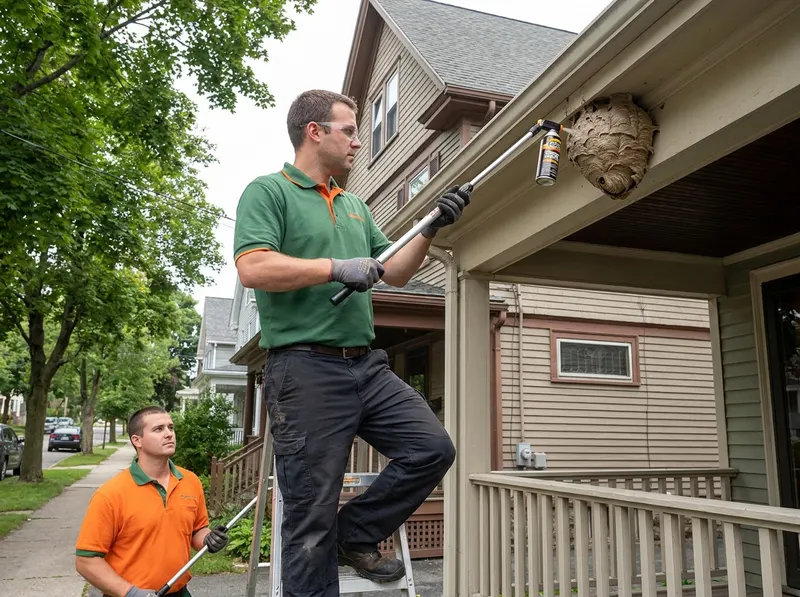
Aerial nests constructed by paper wasps and bald-faced hornets routinely threaten entryways, second-story soffits, and porch ceilings. In historic Wayne County neighborhoods like Boston-Edison, Indian Village, and Palmer Woods, original wood cornices and unsealed fascia boards provide recessed shelter where nests expand unnoticed until colony populations reach 400 to 700 individuals by mid-summer. A standard over-the-counter aerosol spray disperses worker insects into living quarters and fails to penetrate the protective paper layers housing the queen. Professional eradication neutralizes active broods using calibrated localized applications before physical extraction occurs, preventing defensive swarming near windows and walkways. The trade-off between exterior localized removal and interior structural drilling centers on nest depth: exposed eave attachments permit direct detachment without wall modification, whereas colonies settled behind brick veneer in Woodbridge or Corktown require precision dusting through existing weep holes to prevent indoor migration into bedrooms.
Residential architecture throughout Midtown and Rosedale Park presents diverse nesting substrates, ranging from detached garage rafters to two-story cedar overhangs. Ground-nesting yellow jackets and aerial paper wasps require contrasting removal protocols based on flight dynamics and defensive triggers. Aerial hornets build enclosed, grey cellulose globes that hang from tree limbs or attic peaks, necessitating protective micro-encapsulated treatments prior to physical detachment. Ground-dwelling colonies entering through masonry gaps in Southwest Detroit demand pressurized subsurface injection that eliminates hidden brood combs without damaging foundation mortar. Following colony neutralization, all anchoring materials are scraped flush and treated with biological repellents to disrupt chemical scent trails, ensuring returning foraging insects do not rebuild on the exact architectural footprint.
Effective defense involves a straightforward three-stage procedure. First, technicians map exterior flight paths and identify active structural openings along rooflines. Second, workers execute targeted micro-injection directly into the primary nest aperture, collapsing colony activity without scattering stinging insects into adjacent yards. Third, the physical nest is dislodged, sealed in heavy-gauge disposal units, and the substrate is reinforced with copper mesh or silicone sealant at nearby gaps measuring 1/4-inch or larger. Homeowners can reach dispatch at (231) 379-1905 to arrange on-site inspection.
Every job gets a firm, written price after a free on-site visit.
Tell us about your stinging insect and aerial nest removal job in Detroit and we'll send a clear, written quote, usually the same day.
 Orelvo Pest Prevention