Pavement ant activity in Wayne County intensifies during early spring and peak summer heat when subterranean colonies forage for sugars, proteins, and dead insects. In historic brick and limestone foundations found…
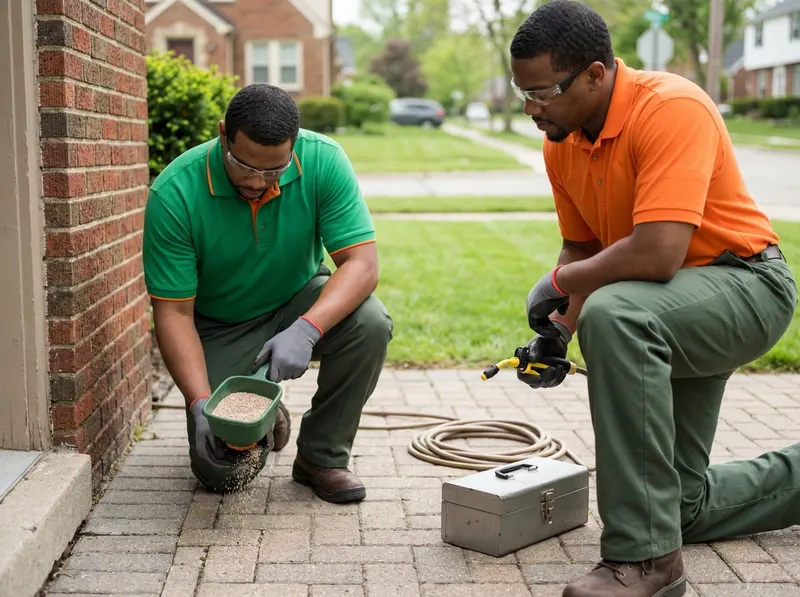
Pavement ant activity in Wayne County intensifies during early spring and peak summer heat when subterranean colonies forage for sugars, proteins, and dead insects. In historic brick and limestone foundations found throughout Indian Village and Boston-Edison, worker ants exploit lime mortar degradation and hairline baseline cracks, establishing indoor scent highways directly into kitchen dry-storage cabinets. Standard aerosol sprays scatter these trails through a biological response known as budding, which causes a single colony to fracture into multiple productive queens. Eradication relies on slow-acting carbohydrate and protein matrix baits that workers transport back below concrete driveways, sidewalk slabs, and basement floor pads to eliminate the queen and brood within 7 to 14 days.
Properties in Corktown, Woodbridge, and Midtown frequently feature slab-on-grade construction, attached masonry patios, or updated concrete flooring where sub-slab voids provide stable thermal protection across freezing winter cycles. For homes in Palmer Woods and Rosedale Park with extensive decorative pavers, ground moisture accelerates soil subsidence beneath slabs, creating natural nesting cavities adjacent to structural sill plates. Treating these sites requires non-repellent liquid micro-injections along exterior slab seams rather than broad perimeter sprays, ensuring the chemical binds to masonry pores without leaving surface residues that evaporate under ultraviolet exposure.
Resolution follows three procedural steps: 1. Mapping worker distribution patterns across kitchen baseboards, plumbing chases, and exterior foundation ledges. 2. Stationing child- and pet-tamper-resistant gel baits along confirmed pathways while applying targeted exterior perimeter deposits. 3. Documenting physical entry gaps larger than 0.5 millimeters along expansion joints, masonry transitions, and plumbing penetrations for exterior silicone- or copper-mesh exclusion sealing. Because pest migration often tracks municipal alleyway pavement borders across Southwest Detroit, routine sealing prevents adjacent colonies from re-establishing dominance over vacant subterranean tunnels.
Every job gets a firm, written price after a free on-site visit.
Tell us about your pavement ant and nuisance ant eradication job in Detroit and we'll send a clear, written quote, usually the same day.
 Orelvo Pest Prevention